Hyaluronic acid fillers: risks, red flags and reversal
A hyaluronic acid filler is a cross-linked gel that holds water and holds shape for roughly 6 to 18 months, depending on how tightly the chains are bonded and where the gel sits. Serious problems are uncommon, with significant complications reported at 0.1 to 1 percent of treatments and vascular occlusion under 0.05 percent, both probably undercounts, but the rare event that matters is gel entering an artery. It is also the one filler class that can be taken back out, because the enzyme hyaluronidase breaks the gel down, which is why the person injecting you should keep it on the shelf.
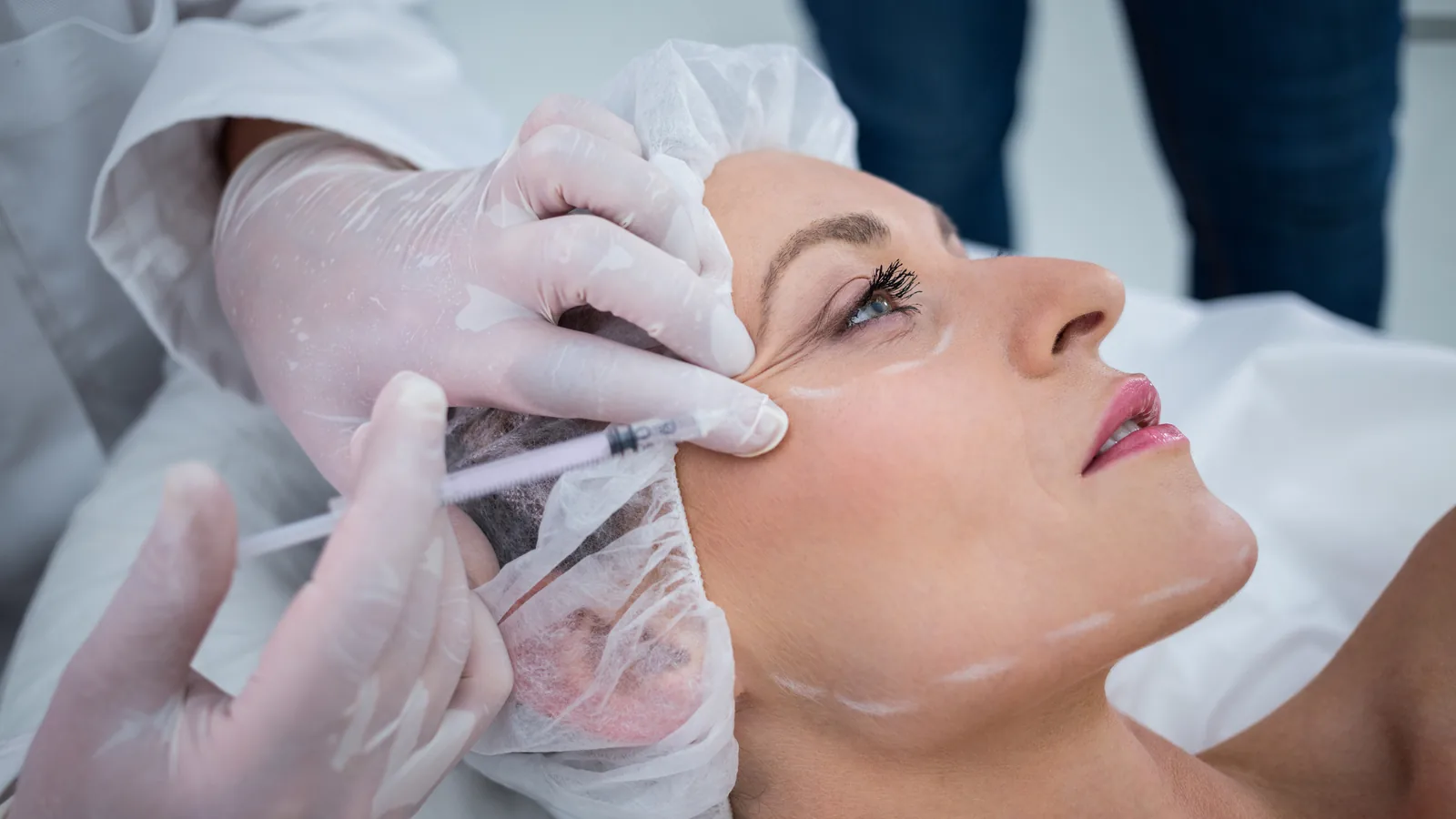
What a hyaluronic acid filler actually is
Hyaluronic acid is a sugar chain your skin already makes, and in its free form it does not last. To sit under a cheek for months it has to be cross-linked: short chemical bridges between the chains turn a soluble solution into a three dimensional mesh. How much of the molecule has been altered is the degree of modification, and an analysis of 13 products from 7 manufacturers found 1 to 8 percent: 3 biphasic gels at 1 percent, the other 10, all monophasic, between 4 and 8 percent.
The starting material matters as well. Hyaluronic acid used in soft tissue fillers ranges from roughly 500 to 6,000 kilodaltons in molecular weight, and the finished gels are graded by a stiffness measure called G prime, reported in pascals. Manufacturers rarely publish it, so you cannot rank products by a number on a box. What it predicts is placement: a stiff gel belongs deep over bone and shows if it goes into the dermis, while a soft gel placed deep will not hold a shape.
What you see on the day is not the result. In one series of reported adverse events, swelling was the commonest entry at 60.1 percent, ahead of nodules at 33.7 percent and pain at 22.6 percent. The face at day 1 is not the face at week 2, which is why adding more gel at a first review is usually the wrong move.
| Event | Reported frequency | Usual timing | What it needs |
|---|---|---|---|
| Swelling | 60.1 percent of reported adverse events | 0 to 14 days | Cold compress, time, review at 2 weeks |
| Nodules and lumps | 33.7 percent of reported events; granulomas about 1 to 2 percent with permanent materials | Days to years | Assessment, hyaluronidase for hyaluronic acid gels |
| Pain at the site | 22.6 percent of reported events | First 72 hours | Review if it worsens rather than settles |
| Migration of gel | Up to 1 percent of cases | Months to years | Assessment, usually dissolving, not more filler |
| Vascular occlusion | Under 0.05 percent in one 2026 review | Minutes to 5 days | Emergency high dose hyaluronidase |
| Necrosis after intra-arterial injection | 0.1 to 0.3 percent quoted in reviews | 1 to 14 days | Urgent specialist care, wound management |
| Vision loss | Fewer than 1 per 10,000 injections | Immediate | Emergency eye care, prognosis often poor |
How long it lasts and why the number moves
The 6 to 18 month range is an average, not a schedule, and the figures come from the manufacturers rather than from independent trials that compare products head to head. A rheology review lists them product by product: monophasic gels at 12 months, one family at up to 18, a lightly modified biphasic gel at about 6 months with retreatment every 6 to 9 months. Nobody can tell you in advance which end of that band your face will land on.
Movement shortens it. A lip is pursed, squeezed and warmed all day, so gel there fades sooner than the same gel deep on a cheekbone, pressed against bone and barely moving. Heavier cross-linking also resists your own hyaluronidase, because the mesh slows the enzyme's access to the chains, which is what makes a stiff gel slower to dissolve on purpose. A 1 percent modified product and an 8 percent one differ both going in and coming out.
Filler does not always leave quietly. Reviews put migration, gel travelling away from where it was placed, at up to 1 percent of cases and tissue atrophy under the gel at under 1 percent. Some nodules appear within days and settle alone; others surface months or years later, often after dental work, an infection or a vaccination, and need assessment rather than a top up.
When a filler is a bad idea
Nobody under 18 should be injected for cosmetic reasons, and in England that is law rather than advice. The Botulinum Toxin and Cosmetic Fillers (Children) Act 2021 received Royal Assent on 29 April 2021 and came into force on 1 October 2021. Administering or arranging a cosmetic filler injection for anyone under 18 is an offence carrying an unlimited fine, and it is a defence only for a registered medical practitioner, or a regulated health professional acting under that doctor's direction.
Postpone if you have an active skin infection, a cold sore or inflamed acne at the site, or any systemic infection. Declare keloid scarring, an autoimmune or inflammatory condition, a previous granulomatous reaction to any injectable, an allergy to a local anaesthetic, since most gels carry one, and any severe reaction to a bee or wasp sting, which is a contraindication to hyaluronidase, the antidote. Blood thinners do not rule treatment out, but they raise the odds of bruising and your injector needs to know. Pregnancy and breastfeeding are a reason to wait, because these gels have not been studied in that group and the treatment is elective.
Reversibility is a reason to choose the material. Granulomatous reactions have been reported in roughly 1 to 2 percent of patients treated with polymethylmethacrylate, and around 6 percent with older collagen injections, and none of that responds to an enzyme. If being able to undo the work matters to you, that argues for a hyaluronic acid gel and against anything sold as long lasting or permanent. Be honest about the area too: previous occlusion, scarring or nasal surgery mean your anatomy is no longer the published average.
| Area | What makes it exposed | How one 2026 review ranks it |
|---|---|---|
| Glabella, between the brows | Small end arteries with connections towards the eye | Ranked highest for blindness and necrosis |
| Nose and nasal tip | Dense arterial supply, tight skin, scarring after occlusion | Ranked very high risk |
| Forehead | Vessels connect to the ophthalmic artery | Ranked very high risk |
| Nasolabial fold | Linked to necrosis and embolic events | High risk, 14.6 percent of reported events |
| Tear trough | Thin skin and vessels close to the orbit | High risk, vision loss reported |
| Cheek | Large volumes placed, deep planes | Not in the high risk ranking, but 32 percent of reported events |
| Lips | Superficial vessels, constant movement | Moderate risk, 17.9 percent of reported events |
The red flags of a blocked vessel
Vascular occlusion means filler has entered an artery, or is pressing hard enough on one to stop the flow. A 2026 review puts it at under 0.05 percent, necrosis after intra-arterial injection at 0.1 to 0.3 percent and vision loss at fewer than 1 per 10,000 injections, while stressing that reporting is voluntary and the real rates are higher. Rare is not the same as ignorable, because the window in which it can be treated is measured in hours, not days.
Four signs matter. Blanching comes first: the skin turns white, often in a streak that follows the line of a vessel rather than the shape of the injection. Dusky skin follows, a mottled, blue-grey or net-like pattern appearing over minutes to hours. Pain that is severe or out of proportion to a needle is the third, although pain can be absent where a local anaesthetic sits in the gel, so its absence proves nothing. Any change in vision is the fourth and the most urgent: blurring, a curtain across part of the field, double vision, a drooping lid or pain behind the eye.
Timing varies more than people expect. A meta-analysis of 14 studies published between 2009 and 2022 pooled 31 reported occlusions: 13 showed immediately, 6 within a day, 10 between 1 and 5 days, 2 later still. Of those 31, 18 (58.06 percent) recovered completely and 4 (12.9 percent) not at all, and delays beyond 5 days tracked with permanent deficits. That is a thin base of published cases, so read it as a pattern rather than a prognosis. If any of these signs appear, ring the clinic the same hour, and treat a visual symptom as an emergency eye problem rather than a cosmetic one.
Reversal, and choosing who holds the syringe
Hyaluronidase is an enzyme that cuts hyaluronic acid chains, and it is why this filler class is treated differently from every other. In the UK it is a prescription only medicine used off label for dissolving filler, so a clinic can only hold it if someone there can prescribe it or has a prescriber reachable.
Doses depend on the problem, and the evidence behind them is thin. A scoping review found 5 trials in 53 people, all dissolving gel placed in arm or back skin, with no trial evidence for reversal in a face or a blocked vessel. Those trials used 1.25 to 37.5 units for every 0.1 millilitre of gel removed. For an occlusion the same review reports 500 to 1,500 units infiltrated through the area at hourly intervals and 1,500 units into the artery itself in hospital series, with no agreed protocol. Outcomes were better when the enzyme was given early, under 4 hours from the filler injection, and within 2 days where skin was threatened. In a separate meta-analysis 16 of 19 hyaluronic acid cases, 84.2 percent, ended in partial or complete recovery.
The enzyme carries risk of its own. Type I hypersensitivity is estimated at about 0.1 percent, and some practitioners test with 3 units intradermally before an elective dissolve, though that test is skipped in an emergency because the clock matters more. Dissolving is not precise surgery either: it removes gel unevenly, and a repeat session at 2 week intervals is common for elective removal.
So the questions before you book are short. Which public register carries the injector's entry, is hyaluronidase in the building on the day, who prescribes it, and what is the out of hours number? Someone who cannot answer those is asking you to accept a risk they are not equipped to treat. Our guide to choosing an aesthetic practitioner goes through the checks in order, and the Consultation Checklist turns them into questions for the room.
Ask these before you book
- Is the injector a registered healthcare professional, and on which public register can I check the entry?
- Is hyaluronidase physically in the clinic on the day, and who on site can prescribe it?
- What is the out of hours number if my skin blanches or my vision changes that evening?
- Which gel, how many millilitres, and in which layer of the face?
- How often has this practitioner treated this area, and what is the plan if it occludes?
- Have I declared blood thinners, immunosuppressants, recent infections, any severe reaction to a bee or wasp sting, and any previous filler, including where and when?
Frequently asked
Can every filler be dissolved?
No. Only hyaluronic acid gels respond to hyaluronidase, while calcium hydroxyapatite, poly-L-lactic acid and permanent materials such as polymethylmethacrylate cannot be broken down by the enzyme. Granulomatous reactions have been reported in roughly 1 to 2 percent of patients treated with permanent material, and those are managed medically or surgically.
How quickly does a blocked vessel need treating?
Within hours. Reviews of hyaluronidase use report better outcomes when the enzyme is given under 4 hours after the filler injection, and a systematic review of 14 studies found that delays beyond 5 days tracked with permanent deficits.
Does filler move from where it was placed?
Migration is reported in up to 1 percent of cases, most visibly around the lips and the area below the eyes. It is a reason for assessment and often for dissolving, not a reason to add more gel on top.
Is filler safe in pregnancy or while breastfeeding?
These gels have not been studied in pregnancy or breastfeeding, and the treatment is elective, so the usual advice is to wait. Discuss any specific medical reason with your own doctor rather than with a clinic reception.
Who may legally inject filler into someone under 18 in England?
For a cosmetic purpose, nobody. Since 1 October 2021 it has been an offence to administer or arrange such an injection for a person under 18 in England, punishable by an unlimited fine, with an exemption only for a registered medical practitioner or a regulated health professional acting under that doctor's direction.
Why does hyaluronidase sometimes need a second session?
The enzyme removes gel unevenly, so a heavily cross-linked product may need a repeat treatment, usually at intervals of about 2 weeks for elective removal. Type I hypersensitivity to hyaluronidase is estimated at about 0.1 percent, which is why some practitioners test with 3 units intradermally before a planned dissolve, and why a previous severe reaction to a bee or wasp sting counts as a contraindication, since the venom contains hyaluronidase.
Sources
- The rheology and physicochemical characteristics of hyaluronic acid fillers: their clinical implications · Review in the International Journal of Molecular Sciences, 2022, open access through PubMed Central. Used for the 500 to 6,000 kilodalton molecular weight range, the degree of modification of 1 to 8 percent across 13 products from 7 manufacturers (3 biphasic gels at 1 percent, 10 monophasic at 4 to 8 percent), and the 6, 12 and 18 month durations, which the review lists as the manufacturers' own figures rather than trial results.
- Permanent complications after dermal fillers: risks, prevention and management strategies · Review in Aesthetic Plastic Surgery, 2026, open access through PubMed Central. Used for significant complications at 0.1 to 1 percent, vascular occlusion under 0.05 percent, necrosis after intra-arterial injection at 0.1 to 0.3 percent, blindness under 1 per 10,000 injections, migration up to 1 percent, tissue atrophy under 1 percent, granuloma rates, the ranking of facial areas by risk, and the distribution of reported events by area. The authors state that these incidence figures are underestimates because reporting is voluntary.
- Risk factor analysis for vascular occlusions after dermal filler injections: a systematic review and meta-analysis · Systematic review and meta-analysis in Cureus, 2025, pooling 31 reported occlusions from 14 studies published between 2009 and 2022. Used for partial or complete recovery in 16 of 19 hyaluronic acid cases (84.2 percent), complete recovery in 18 of 31 (58.06 percent), no recovery in 4 of 31 (12.9 percent), the time to onset spread, and the association between delays beyond 5 days and permanent deficits. The authors note that published case reports favour severe events.
- A scoping review of hyaluronidase use in managing the complications of aesthetic interventions · Scoping review in Aesthetic Plastic Surgery, volume 48, 2024, published online in December 2022 and open access through PubMed Central. Used for the 5 trials in 53 people, all in arm or back skin, the dose of 1.25 to 37.5 units per 0.1 millilitre of gel removed, 500 to 1,500 units for a vascular occlusion and 1,500 units intra-arterially, the treatment window of under 4 hours, the 0.1 percent hypersensitivity estimate, the bee and wasp sting contraindication, the 3 unit intradermal test and the 2 week repeat interval. The review states that there is no trial evidence for reversal in facial skin and no agreed protocol for vascular complications.
- Botulinum toxin and cosmetic fillers for under 18s: guidance for enforcement officers · UK government guidance on the Botulinum Toxin and Cosmetic Fillers (Children) Act 2021. Used for Royal Assent on 29 April 2021, entry into force on 1 October 2021, the prohibition for anyone under 18 in England, the unlimited fine and the medical practitioner exemption.
Read on
 Aesthetics
Botulinum toxin injections: onset, duration and risks
Aesthetics
Botulinum toxin injections: onset, duration and risks
 Aesthetics
How to choose an aesthetic practitioner: the checklist
Aesthetics
How to choose an aesthetic practitioner: the checklist
 Ingredients
Hyaluronic acid: molecular weight and how to use it
Ingredients
Hyaluronic acid: molecular weight and how to use itTools that fit
This guide is for general information. It does not replace advice from a dermatologist, physician or qualified practitioner, or an examination.