Gel manicures and UV lamps: what the evidence shows
A gel curing lamp is an ultraviolet A source. The unit used in the 2023 laboratory study emitted between 365 and 395 nanometres and stabilised at about 7.5 milliwatts per square centimetre, which works out at roughly 9 joules per square centimetre over a 20 minute run. That dose killed 20 to 30 percent of cultured cells after one session and 65 to 70 percent after three daily sessions, and the authors state both that their work gives no direct evidence of an increased cancer risk in human beings and that they believe the radiation may cause cancers of the hand. No study in people has shown that gel manicures cause skin cancer, and none has shown the exposure to be harmless: 5 published case reports, models whose thresholds run from 8 exposures to 13,000 sessions, and no cohort study is the whole of the file.
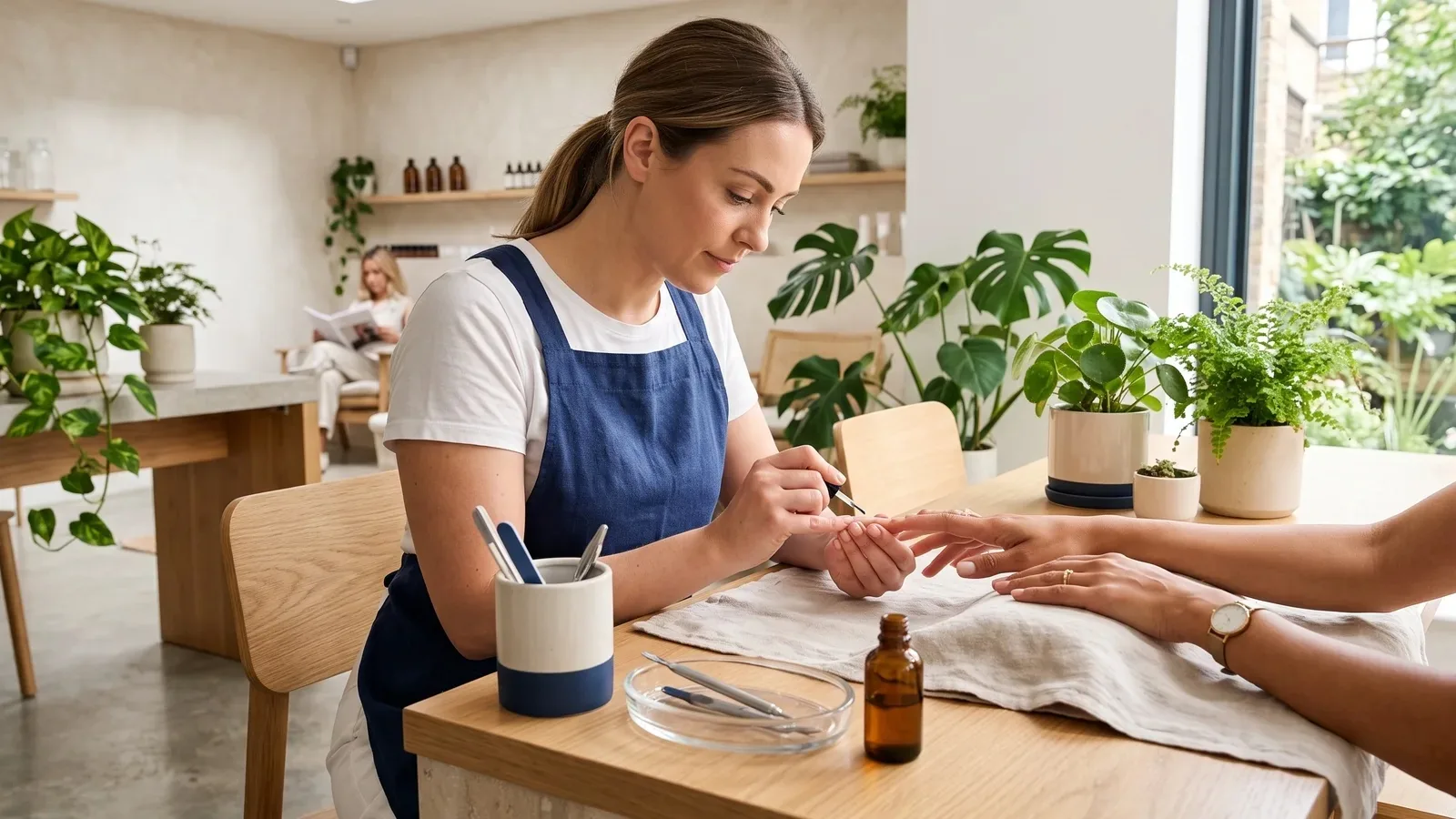
What a curing lamp actually emits
A gel lamp is a small ultraviolet A source. The unit used in the 2023 laboratory work emitted between 365 and 395 nanometres at about 7.5 milliwatts per square centimetre, roughly 9 joules per square centimetre over a 20 minute run. A 2025 review of the field reports one lamp putting out up to 4.2 times more than the sun within the 355 to 385 nanometre band at a UV index of 6, and notes that 10 minutes under a nail lamp matches the daylight exposure limit recommended for outdoor workers.
The exposure is real, and it is narrow: it lands on the backs of the fingers and hands for the minutes the gel is setting, not on the face or the trunk. The same review states that LED lamps emit ultraviolet A as well, generally less than traditional fluorescent units, so choosing an LED lowers the dose rather than ending it. One measurement study cited there found blue light values below the international limits set for both technicians and customers, while noting that the long term effect of that blue light on the retina is not known.
What nobody has is a dose diary. The review could not separate the ultraviolet received during manicures from the ultraviolet everyone collects outdoors, so no study can say what a pair of hands has accumulated over 5 or 10 years of fortnightly appointments. For how ultraviolet dose is counted, see the guide to sunscreen quantity.
| The claim | Kind of evidence | The numbers | How far it goes |
|---|---|---|---|
| The lamp emits ultraviolet A | Measured, spectrometry | 365 to 395 nm, about 7.5 mW per square centimetre, roughly 9 J per square centimetre in 20 minutes | Settled. LED units emit it too, generally less |
| The dose kills cells | Measured, cell culture | 20 to 30 percent death after 1 session, 65 to 70 percent after 3 | Dishes of cells, not skin. A 4 minute exposure left viability unchanged |
| It leaves mutations | Measured, sequencing of irradiated cells | Signatures SBS18 and SBS36 enriched | Shown in culture, not in human skin |
| Yearly dose from salon visits | Modelled | 1.1 to 1.5 minimal erythema doses a year | Depends entirely on assumed frequency and lamp |
| Sessions before extra cancers | Modelled | 13,000 sessions under 9 watt units, or 8 to 208 exposures to reach 60 J per square centimetre | Different endpoints, so the two numbers are not comparable |
| Skin cancer in frequent users | Case reports | 5 reports among 17 articles, histories of 4 to 12 years and longer | No denominator, so no rate |
| Population risk to the hands | One retrospective comparison | 10 year chart review, ultraviolet light not a significant factor | Small, backward looking, no prospective cohort exists |
| Nail thinning after removal | Measured | 0.63 mm to 0.50 mm on ultrasound, 0.59 mm to 0.30 mm on confocal imaging | Figures quoted from earlier work, small samples, filing drives it |
| Acrylate allergy | Measured, patch testing | 38.6 percent of 396 suspected cases positive, 78.8 percent of 113 beauticians | A clinic population, so higher than the street |
What the 2023 cell study showed and what it did not
The study behind the current worry irradiated cells, not people: mouse embryonic fibroblasts, human foreskin fibroblasts and adult human epidermal keratinocytes. The acute protocol was two 20 minute sessions in one day with a 60 minute break between them, the chronic protocol one 20 minute session a day for 3 consecutive days. A single 20 minute irradiation killed 20 to 30 percent of the cells; three consecutive sessions killed between 65 and 70 percent.
The survivors showed oxidative damage. Reactive oxygen signals in the keratinocytes rose 5.5-fold after acute exposure and 4.4-fold after chronic exposure, a mitochondrial marker rose 8.3-fold and 17-fold, and the oxidised base 8-oxo-dG was enriched 5 to 20-fold against controls. Sequencing found two mutational patterns, catalogued as SBS18 and SBS36, both associated with reactive oxygen damage.
The authors drew the limits themselves, in both directions. Their paper states that while the radiation is cytotoxic, genotoxic and mutagenic, it does not provide direct evidence for an increased cancer risk in human beings. They add that their results and the prior evidence strongly suggest the radiation may cause cancers of the hand, and that the studies needed to quantify that would take at least a decade. Cells in a dish lack what a hand has: a stratum corneum, pigment, a blood supply and repair over weeks. A different in vitro experiment described in the 2025 review used 4 minutes of exposure, closer to a real curing cycle, and found no significant change in cell viability.
Where the modelled risk lands
Between the dish and the clinic sit the models, and they disagree. One put habitual nail lamp use at 1.1 to 1.5 minimal erythema doses a year, roughly the ultraviolet needed to just redden skin, confined to the hands. Another calculated that 13,000 sessions under 9 watt fluorescent units would be needed before extra keratinocyte carcinomas appeared. A third set a damage threshold at an energy density of 60 joules per square centimetre, reached in a minimum of 8 to 208 exposures. A range from 8 to 208 is not a number to plan around, and the three models do not share an endpoint.
Then there are the case reports. The 2025 scoping review, searching to January 2024, kept 17 articles: 12 studies and 5 case reports. The reports describe squamous cell carcinoma on the backs of hands and feet in people with long histories of gel manicures, among them two patients with systemic lupus erythematosus whose regular use ran 4 to 12 years, and some needed extensive resection or amputation of a digit. Case reports have no denominator: they cannot say how many people had the same manicures for the same years and developed nothing.
The only population comparison in the review is a 10 year retrospective chart review setting patients with basal or squamous cell carcinoma against patients with non-malignant verruca, in which ultraviolet light did not emerge as a significant risk factor for carcinomas of the hands. It is small, it looks backwards, and it stands alone. A risk that is unquantified, not shown to be zero and never counted in a large group of users is the accurate position in 2026. The dermatology guidance cited here does not wait for that count: it states that repeated use can raise the risk of skin cancer and premature ageing on the hands.
The damage that comes off with the polish
Most people who give up gel manicures do so because of their nails. The usual complaints are thinning, brittleness, ridging, traumatic onycholysis where the plate lifts away from the bed, and keratin granulations. The measurements blame the filing and the products applied, not the lamp.
A 2022 study, which its authors call preliminary, measured the thumbnail of the dominant hand in 20 women. Each wore a hybrid manicure for 3 weeks, after which it was taken off by filing with a 100 grit coarse file and a rotary tool. Casts were scanned before and afterwards with points recorded every 20 micrometres. The smallest change sat at the proximal part near the cuticle, while the middle and the free edge, where the file spends most of its time, changed about equally and more. Earlier measurements quoted in the same paper put average nail thickness at 0.63 mm before a gel manicure and 0.50 mm after removal on ultrasound, and 0.59 mm against 0.30 mm under reflectance confocal microscopy.
That points at technique rather than radiation. Dermatologists advise soaking only the fingertips in acetone, not the whole hand, after which the polish should lift after about 15 minutes, and never picking at a gel that is still holding. A gap of 1 to 2 weeks without polish between sets, with a moisturiser or petroleum jelly on nails and cuticles, is the other half of that advice.
Acrylate allergy, the harm that is documented
The evidence on allergy is far firmer than the evidence on cancer. At one tertiary centre, 3,828 patients were patch tested between June 2013 and July 2022. Of those, 396 (10.3 percent) were suspected of nail acrylate allergy and tested with an extended acrylate series, and 153 of them (38.6 percent) reacted to at least one acrylate. All 153 were female.
The occupational split is the striking part: 78.8 percent of the 113 beauticians tested reacted, against 22.6 percent of the 283 consumers. Hand dermatitis was the usual picture, in 141 of the 153 (91.5 percent). The face was involved in 25 (16 percent) and the eyelids in 11 of those 25 (44 percent). A technician handling uncured product through a working day carries an exposure their clients do not.
Testing has to be wide enough: 22 of the 153 (14.4 percent) would have been missed had only 2-hydroxyethyl methacrylate been tested, so ask for the extended acrylate series rather than the baseline panel. See a doctor if the skin around your nails itches or cracks, if a nail lifts, or if your eyelids swell after an appointment, and ask about occupational assessment if you work with these products. Sensitisation lasts; it does not fade with a different colour. The SPF Day Planner covers what goes on the hands before the lamp.
Practical protection, in the order the evidence supports it
- Put a broad spectrum, water resistant sunscreen of SPF 30 or higher on the backs of your hands before the appointment, or wear dark opaque gloves with the fingertips cut off.
- Ask whether the unit is an LED type. It still emits ultraviolet A, generally less than an older fluorescent lamp, so this lowers the dose rather than removing it.
- Have the gel soaked off: fingertips only in acetone, and after about 15 minutes the polish should lift.
- Never pick or peel a gel that is still holding. The thinning in these studies followed filing and abrasive removal, not the lamp.
- Leave 1 to 2 weeks without polish between sets and use a moisturiser or petroleum jelly on the nails and cuticles.
- Ask for patch testing with an extended acrylate series if your skin itches or a nail lifts, since 14.4 percent of the positive cases at one centre would have been missed by testing 2-hydroxyethyl methacrylate alone.
- If you work as a nail technician, treat hand dermatitis as an occupational matter: 78.8 percent of the 113 beauticians tested at that centre were sensitised.
- If you have lupus or another photosensitive condition, take a photosensitising or immunosuppressive medicine, or have had a skin cancer on your hands, ask your doctor before regular gel work.
Frequently asked
Do gel manicures cause skin cancer?
No study in people has shown that, and none has shown the exposure to be harmless. What exists is a cell culture study whose authors believe the radiation may cause cancers of the hand, models whose thresholds run from 8 exposures to 13,000 sessions, and 5 published case reports, set against one small retrospective comparison in which ultraviolet light was not a significant risk factor for carcinomas of the hand. Dermatology guidance therefore tells people to cover their hands rather than to give up the lamp.
Is an LED lamp safer than a UV lamp?
LED curing lamps also emit ultraviolet A, generally less than older fluorescent units, so the switch lowers the dose rather than removing the exposure. No trial has compared skin outcomes between the two types.
Does sunscreen on the hands actually help?
Dermatologists advise a broad spectrum, water resistant sunscreen of SPF 30 or higher on the hands before a gel manicure, or dark gloves with the fingertips cut off. A 2025 review judged the evidence too thin to make either compulsory, while noting that several papers consider both sensible.
Why are my nails thin and ridged after gel polish?
That damage tracks with removal rather than with the lamp. In one study 20 women wore a hybrid manicure for 3 weeks and had it filed off with a 100 grit file and a rotary tool, and scans showed the deepest change at the free edge; earlier ultrasound measurements put average thickness at 0.63 mm before and 0.50 mm after.
Can I become allergic to gel polish?
Yes, and it is the best documented harm of gel work. At one centre 153 of the 396 people tested for suspected nail acrylate allergy reacted, 91.5 percent of them with hand dermatitis, and beauticians were affected more than three times as often as consumers.
How often is too often?
No study sets an interval, because nobody has counted skin cancers against sessions in a large group. The advice to leave 1 to 2 weeks without polish between sets is aimed at the nail plate, not at the lamp.
Sources
- Zhivagui M, Hoda A, Valenzuela N, et al. DNA damage and somatic mutations in mammalian cells after irradiation with a nail polish dryer. Nat Commun. 2023;14:276 · Open access primary study, read in full. Source of the emission range of 365 to 395 nm and the irradiance of about 7.5 mW per square centimetre, the three cell types, the acute protocol of two 20 minute sessions with a 60 minute break and the chronic protocol of one session a day for 3 days, the 20 to 30 percent and 65 to 70 percent cell death figures, the reactive oxygen and mitochondrial fold changes, the signatures SBS18 and SBS36, and the authors' own two sided statement that the work does not provide direct evidence for an increased cancer risk in human beings while their results and the prior evidence strongly suggest the radiation may cause cancers of the hand, with large epidemiological studies likely to take at least a decade.
- Beylin D, Kornhaber R, Le Lagadec D, Cleary M. Assessing the health implications of UV/LED nail lamp radiation exposure during manicure and pedicure procedures: a scoping review. Int J Dermatol. 2025;64(4):659 to 666 · Scoping review searching to January 2024, read for the synthesis. Source of the count of 17 articles (12 studies and 5 case reports), the modelled figures of 1.1 to 1.5 minimal erythema doses a year, 13,000 sessions under 9 watt fluorescent units and 8 to 208 exposures to an energy density of 60 J per square centimetre, the output up to 4.2 times the sun within 355 to 385 nm at UV index 6, the 10 minute comparison with the daylight limit for outdoor workers, the note that LED lamps emit less ultraviolet A than traditional units, the 4 minute in vitro exposure that did not change viability, the squamous cell carcinoma case reports including the two lupus patients with 4 to 12 years of use, and the 10 year retrospective chart review that found ultraviolet light was not a significant factor for hand carcinomas.
- Zdrada J, Odrzywolek W, Deda A, et al. Application of a three dimensional scanner to the quantitative assessment of the nail plate condition after a hybrid manicure procedure: preliminary study. Skin Res Technol. 2022;28(3):427 to 432 · Open access measurement study, read in full. Source of the 20 participants and thumbnail method, the 3 week wear, the removal by 100 grit file and rotary tool, the scanning resolution of 20 micrometres, the finding that the smallest change was proximal and the largest distal, and the ultrasound and confocal figures of 0.63 mm to 0.50 mm and 0.59 mm to 0.30 mm, which the paper quotes from earlier work by other authors rather than measuring itself, together with the list of complications including traumatic onycholysis and keratin granulation.
- Dascalu J, Polansky S, Khamaysi Z, et al. Is the use of the extended (meth)acrylate series nails justified? Characterization of nail acrylate allergy in a tertiary medical centre. Acta Derm Venereol. 2024;104:adv41079 · Open access retrospective patch test study, read for the results section. Source of the 3,828 patients tested between June 2013 and July 2022, the 396 (10.3 percent) tested with the extended acrylate series, the 153 (38.6 percent) with a positive reaction, the split of 78.8 percent of 113 beauticians against 22.6 percent of 283 consumers, hand dermatitis in 141 (91.5 percent), facial involvement in 25 (16 percent) with eyelids in 11 of those, and the 22 of 153 (14.4 percent) that testing 2-hydroxyethyl methacrylate alone would have missed.
- American Academy of Dermatology. Gel manicures: tips for healthy nails · Patient guidance from a dermatology body, read in full. Source of the practical protections quoted here: broad spectrum water resistant sunscreen of SPF 30 or higher on the hands before a gel manicure or dark opaque gloves with the fingertips cut off, soaking only the fingertips in acetone with the polish lifting after about 15 minutes, not picking or scraping the gel, and a break of 1 to 2 weeks without polish with a moisturiser on nails and cuticles. The same page states that repeated use can increase the risk of skin cancer and premature skin ageing on the hands, which is why it advises covering them.
Read on
 Beauty
Fragrance allergens in cosmetics: what must be on the label
Beauty
Fragrance allergens in cosmetics: what must be on the label
 Ingredients
Mineral or chemical sunscreen filters: how they work
Ingredients
Mineral or chemical sunscreen filters: how they work
 Skincare
How much sunscreen a face needs: the 2 mg per square centimetre rule
Skincare
How much sunscreen a face needs: the 2 mg per square centimetre ruleTools that fit
This guide is for general information. It does not replace advice from a dermatologist, physician or qualified practitioner, or an examination.